
Last Updated: October 30, 2026
Quick Summary
There is no official tequila certification called “ERA certified tequila” recognized by the Consejo Regulador del Tequila or the TTB. The phrase is not a defined category or regulatory standard, so treat it as a marketing claim unless the certifying body is named. Verify real credentials instead, such as the NOM number, the agave statement, and the origin.
- The CRT and TTB do not recognize any program called ERA for tequila.
- Check for a four-digit NOM number, which identifies the producer under Mexican rules.
- A “100% de Agave” statement means all sugars came from agave.
- Any seal should name its certifying body, which should keep a public registry.
- Certification confirms origin and identity, not taste or quality.
Table of Contents
- What ERA Certified Tequila Means
- Tequila Certification Explained: Who Checks What
- How to Read a Tequila Label Step by Step
- 100% Agave Tequila Meaning and Why It Matters
- Organic Tequila Certification and What It Covers
- What Certification Does and Does Not Guarantee
- Checking a Bottle Before You Buy It
- Frequently Asked Questions
What ERA Certified Tequila Means
If you searched for “ERA certified tequila,” you have probably seen the phrase on a retailer page, a social post, or a bottle tag and want to know whether it is a real credential. Here is the honest answer: there is no tequila certification program called “ERA” that is recognized by the Consejo Regulador del Tequila (CRT), the body that certifies tequila producers and bottlings, or by the Alcohol and Tobacco Tax and Trade Bureau (TTB), the federal agency that regulates alcohol labeling in the United States.
The Most Likely Explanations for the Phrase
Because “ERA” is not a defined tequila term, the label or listing you saw is probably one of the following:
- A brand or product name. Some producers use “Era” as part of a bottle name or a line extension. A brand name is not a certification, even when it appears next to a seal.
- A typo or misreading of “CRT.” The regulatory council’s mark is the credential that actually matters, and it is easy to transpose letters when copying from a shelf tag or a screenshot.
- A confusion with “extra añejo” or “extra aged.” Those are real age classifications, and the abbreviation “XA” is sometimes written loosely. “Extra añejo” means the tequila was aged at least three years; it says nothing about a certification called ERA.
- A confusion with unrelated “ERA” programs. “ERA” appears in other industries and in some sustainability and environmental programs. None of those programs certify tequila under Mexican or U.S. alcohol rules.
- A retailer’s own shorthand. Some shops invent shelf tags (“Editor’s Reserve Award,” for example) that look like seals. These are store marketing, not regulated certifications.
If a bottle, listing, or influencer claims “ERA certified” and cannot point to a CRT producer number (the NOM) or a named certifying body, treat the claim as unverified. A real certification has a registry entry behind it.
What to Check Instead
Rather than chase a term with no official definition, check the credentials that are real and verifiable on any bottle:
- The word “Tequila” on the label, paired with “100% de Agave” or “Mixto.”
- The NOM number, a four-digit producer code assigned under the Mexican regulatory system.
- The origin statement, “Hecho en Mexico” or equivalent.
- The age classification, blanco, reposado, añejo, or extra añejo.
- Any voluntary seal, organic, kosher, or similar, with the certifying body named.
Those five items tell you where a tequila was made, who made it, and what is in it. A phrase like “ERA certified” adds nothing you can verify until someone defines it.
Why This Matters for Buyers
Terminology confusion is common in the tequila aisle because real credentials (the CRT mark, the NOM, the 100% de Agave statement) sit next to voluntary seals (organic, kosher) and pure marketing language (“handcrafted,” “small batch,” “reserve”). When a term cannot be tied to a registry, the safe move is to fall back on the credentials that can. That is the approach we take at Tiburon Rum with our FIN Tequila, which is made from 100% de Agave in Jalisco, Mexico, and carries the standard producer and origin information you can check yourself.
Tequila Certification Explained: Who Checks What
Tequila is a protected designation. Under Mexican law, the spirit must be produced in designated regions, most of them in Jalisco, and it is overseen by the Consejo Regulador del Tequila (CRT), the regulatory council that certifies producers and their bottlings.
What certification does not do is vouch for taste or quality. A bottle can be fully certified and still not suit your palate. Certification answers the question “is this really tequila from the approved source,” not “is this a good tequila.”
How to Read a Tequila Label Step by Step
A tequila label carries two kinds of information: regulated statements that must be there, and voluntary claims that a producer chooses to add. Learning to tell them apart is the fastest way to judge a bottle before you buy it.
The Regulated Statements
Work through the label in this order:
- Find the word “Tequila.” It should appear alongside the category, such as “100% de Agave” or “Mixto.” A bottle that says only “agave spirit” is not tequila.
- Check the agave statement. “100% de Agave” means every sugar came from agave. A “Mixto” tequila can draw up to 49 percent of its sugars from other sources, typically cane or corn.
- Look for the NOM number. This four-digit code identifies the producer and is assigned under the Mexican regulatory system. It is usually printed near the bottom of the back label.
- Confirm the origin. Look for “Hecho en Mexico” or a statement that the product is made in Mexico.
- Note the age classification. Blanco, reposado, añejo, and extra añejo each describe time in wood, not quality.
The Voluntary Seals, and What Each One Actually Certifies
This is where most buyers get confused, because several seals can appear on the same bottle and they do not mean the same thing:
| Seal or claim | Who issues it | What it confirms | What it does not confirm |
|---|---|---|---|
| CRT / NOM mark | Consejo Regulador del Tequila | The spirit is tequila, made in an approved region by a registered producer | Taste, quality, or agave percentage beyond what the label states |
| “100% de Agave” | Regulated label statement | All sugars came from blue Weber agave | Farming practices or aging |
| USDA Organic | USDA National Organic Program (or a recognized certifier) | How the agave was grown and how the product was handled | That the bottle is tequila, or that it tastes better |
| Kosher seal | A recognized kosher certifying agency | Production met that agency’s kosher standards | Origin, agave content, or quality |
| “Handcrafted,” “artisan,” “small batch,” “reserve” | The producer | Nothing regulated, marketing language | Anything you can verify |
The rule of thumb: if a seal names a certifying body and that body keeps a public registry, it is a real credential. If it names no one, it is a claim.
Distillery Identification Codes
The NOM number links a bottle to the distillery or bottler that produced it. Mexico’s regulatory system assigns this code, and it is how the CRT tracks production. You can use it to cross-check a bottle against the producer named on the label. If a bottle names a distillery but carries no code, that is a reason to look more closely.
How to Verify a Bottle Against Official Records
Reading the label is step one; checking it is step two. A practical verification sequence:
- Write down the NOM number and the producer name exactly as printed.
- Check the producer against the CRT’s public producer directory to confirm the NOM is active and matches the brand.
- For U.S. labels, confirm the mandatory statements, brand name, class and type (“Tequila”), alcohol content, net contents, and the government warning, are present and legible, as required under TTB labeling rules.
- For an organic claim, look up the certifier named on the package in the USDA Organic Integrity Database.
- For any other seal, ask who issues it. If no issuing body is named, treat the claim as unverified.
Consejo Regulador del Tequila producer directory
TTB alcohol labeling guidance
USDA Organic Integrity Database
An Annotated Example
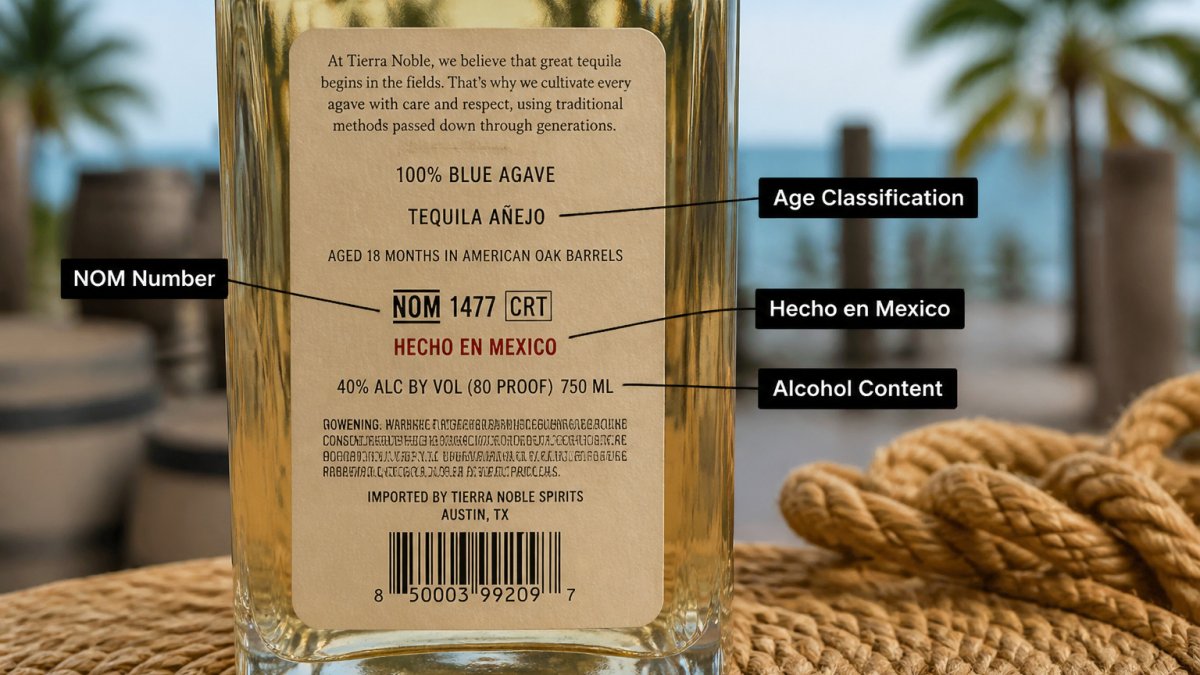
On a typical compliant back label you will see, in roughly this order: the brand name, the class and type (“Tequila”), the agave statement, the NOM number, the origin statement, the age classification if aged, the alcohol content by volume, the net contents, and the government warning.
Classifications: Blanco, Reposado, Añejo
Age classifications describe how long a tequila rested in wood, not its quality:
- Blanco (silver): Bottled soon after distillation, or aged for under two months. It shows the most raw agave character.
- Reposado: Aged at least two months, but less than a year, in oak barrels.
- Añejo: Aged at least one year, but less than three, in barrels of 600 liters or less.
- Extra añejo: Aged at least three years. It is the oldest regulated category.
Each category suits a different use. Many people mix blanco in cocktails and sip añejo or extra añejo neat.
A label you can trust names its credentials and lets you check them. If a claim, including “ERA certified”, cannot be traced to a registry or a named certifying body, fall back on the NOM, the agave statement, the origin, and the age classification.
100% Agave Tequila Meaning and Why It Matters
A “100% de Agave” tequila is made only from sugars derived from the blue Weber agave plant. A Mixto tequila is allowed to draw up to 49 percent of its sugars from other sources, typically cane or corn-based sweeteners.
For buyers who want a spirit that reflects the agave plant itself, the 100% label is the thing to look for. It is printed on the front of most bottles, so it is one of the easiest checks you can make in a store.
Organic Tequila Certification and What It Covers
Organic certification is separate from the tequila designation. An organic tequila carries a certification from a recognized body, and in the United States the USDA National Organic Program sets the rules for organic labeling.
An organic seal does not confirm that a bottle is tequila, and a non-organic tequila is not necessarily lower quality. Organic certification is a choice about farming practices, and it sits alongside the tequila rules rather than replacing them.
What Certification Does and Does Not Guarantee
Certification confirms a set of things: the spirit is tequila under Mexican law, it came from an approved region, and the producer is registered. It gives you a traceable chain from bottle to producer.
It does not guarantee flavor, smoothness, or that a bottle will suit you. Two certified blancos can taste completely different. Use certification as a floor for trust, then decide on taste.
Checking a Bottle Before You Buy It
Before you buy, run through this short checklist:
- The label says “Tequila,” and states “100% de Agave” if that is what you want
- A four-digit NOM number is printed on the back label
- “Hecho en Mexico” or an equivalent origin statement appears
- The age classification matches how you plan to drink it
- Any organic claim references a recognized certification body
If you want to see how these details look on a bottle, our FIN Tequila pages show each label section. Read more about verifying authenticity in our guide to checking tequila authenticity before you buy. For ranked options once you know what to look for, our premium tequila for sipping roundup is a good next step.
Frequently Asked Questions
Is ERA certification the same as CRT certification?
No. The Certificate of Regulatory Compliance (CRT) is the document issued by the regulatory council that confirms a producer meets the standards for tequila. ERA is a separate certification mark and does not replace the CRT. Shoppers should check whether a bottle carries the CRT producer identifier and what the ERA mark specifically claims, rather than assuming the two terms mean the same thing.
What is the difference between certified tequila and 100% agave tequila?
Certified tequila means the producer has been verified as meeting regulatory requirements for production and labeling. 100% agave tequila is a production claim meaning every sugar used came from agave. A bottle can be certified without being 100% agave, and a 100% agave tequila is not automatically certified under a particular mark. Read the label for both the producer information and the agave statement.
How can you tell whether tequila is certified?
Look on the label for the producer or bottler identifier, often a four-digit NOM code, and for any certification mark. Verifying the producer through official regulatory sources is the most reliable check. Certification marks alone do not prove a bottle’s contents, so treat the identifier and the agave statement as the main points to confirm.
