
Last Updated: November 18, 2026
Quick Summary
To cut lime wedges, trim a quarter inch off each end, cut the lime in half lengthwise, then slice each half into three or four even wedges about a half inch wide. Use a sharp paring knife on a stable board so the blade doesn’t crush the fruit or release bitter pith.
- Slice off about a quarter inch from each end so the lime sits flat and steady.
- Cut lengthwise from end to end, placing each half flat side down with the peel facing up.
- Aim for wedges about a half inch wide at the peel so they sit well on the rim.
- Keep your knife just inside the flesh to avoid bitter pith in the drink.
- Store cut wedges in an airtight container lined with a dry paper towel, chilled.
Table of Contents
- Tools You Need for Cutting Limes
- How to Cut Lime Wedges for Drinks Step by Step
- How to Cut Limes Without the Pith
- Bartender Cutting Methods and Yield Tips
- How to Cut a Lime Garnish for Presentation
- How to Keep Cut Lime Wedges Fresh
- Start Cutting Your Next Round of Wedges
- Frequently Asked Questions
Tools You Need for Cutting Limes
Cutting clean lime wedges takes very little equipment, but the right tools make the job faster and safer. Bartenders and home mixologists alike start with the same basics.
- A sharp paring knife with a 3 to 4 inch blade gives you control over small cuts.
- A stable cutting board that will not slide. A damp towel under the board works well.
- A small bowl for holding finished wedges.
- A citrus press or reamer if you plan to juice the same limes after cutting.
A dull blade crushes the fruit instead of slicing it, which releases bitter oils and makes the wedges messy. Sharpen your knife or replace it before you start a big batch.
How to Cut Lime Wedges for Drinks Step by Step
Start with firm, fresh limes that feel heavy for their size. A lime that gives under light pressure is past its peak and will cut into ragged, mushy wedges. Roll each lime on the counter with your palm for a few seconds first. This loosens the juice sacs and gives you more juice later.
Trimming the Ends Off the Lime
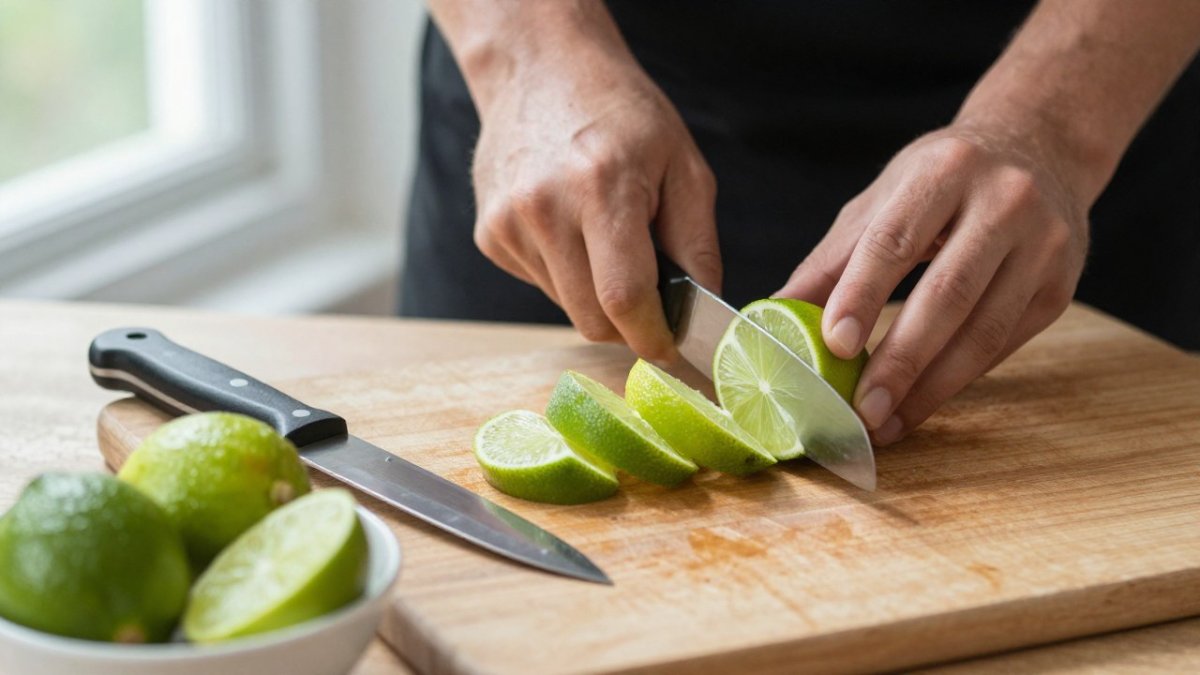
Set the lime on the board. Slice off about a quarter inch from each end. This creates two flat surfaces, so the lime sits steady and the knife tracks straight instead of skating.
Watch out: Cut only the very tips. Going deeper exposes too much pith and wastes flesh, and a lime trimmed too far will not sit flat for the next cut.
Halving and Creating Uniform Wedges
Stand the lime on one flat end and cut it lengthwise from end to end into two halves. Place each half flat side down so the peel faces up. Slice each half into three or four even wedges, working from one end to the other.
Aim for wedges about a half inch wide at the peel. That width gives you a wedge that sits on the rim without tipping and releases juice evenly when squeezed. Count your wedges on the first lime of a batch so you know what a consistent cut looks like before you speed up.
Keep the blade perpendicular to the board and let the full length of the edge do the work. Pressing straight down with the tip alone crushes the flesh near the peel and leaves a frayed edge that looks tired in the glass.
Squeezing Versus Garnishing Wedges
Decide before you cut whether each wedge is for the rim or for juice. Garnish wedges want a clean, intact peel and a slightly thicker cut so they hold their shape. Juice wedges can be cut thinner and squeezed immediately. Cutting for the job you actually need is the simplest way to cut less waste and get better drinks every time.
The core steps for cutting lime wedges come down to a few decisions about trim depth, wedge width, and purpose.
| Step | What to do | Key detail |
|---|---|---|
| Trim ends | Slice off a quarter inch from each end | Creates flat surfaces so the lime sits steady |
| Halve | Cut lengthwise end to end, flat side down | Peel faces up for a stable cut |
| Wedge | Slice each half into three or four even wedges | Aim for about a half inch wide at the peel |
| Choose purpose | Decide garnish or juice before cutting | Garnish wedges stay thicker; juice wedges can be thinner |
How to Cut Limes Without the Pith
Pith is the white layer under the peel. It tastes bitter, so keep your knife just inside the flesh. Press the blade down with a gentle sawing motion instead of forcing it through.
A common mistake is cutting too close to the peel on the first pass. Work slowly and check the edge of each wedge. A clean white-free edge means you cut at the right depth.
Bartender Cutting Methods and Yield Tips
Professional bartenders cut limes to get the most juice with the least waste, and the method they use depends on what the drink needs. Two approaches cover most of the work.
The wedge-first method cuts the lime into wedges and then squeezes the rinds by hand or with a press. This is the highest-yield approach for a shift because every wedge gets squeezed and the peel oils land in the drink. It is slower per lime but wastes almost nothing.
The half-and-quarter method cuts the lime in half, juices the halves on a press, then cuts the spent halves into wedges for garnish. This is faster for high-volume service but leaves more juice behind in the press and the rind.
Choosing the Right Knife
A paring knife with a 3 to 4 inch blade is the right tool for wedges because it gives you control over small, even cuts. A chef’s knife is faster for halving a lime and works well when you are cutting a whole case at once, but the long blade makes it harder to feel the pith line on a thin wedge. Many bartenders reach for the paring knife for garnish and the chef’s knife for bulk prep.
Getting More Wedges Per Lime
Yield comes down to three things: trimming less off the ends, cutting wedges at a consistent width, and squeezing every rind. Trimming only the tips instead of a thick slice preserves flesh that would otherwise be thrown away. Cutting to a consistent half inch means no wedge is too thin to squeeze and none is too thick to fit the glass. Keeping the trimmed ends and spent rinds in a separate bin lets you see how much fruit each batch actually uses.
Troubleshooting Common Problems
Mushy limes are usually overripe or were stored too cold and then warmed up. Cut them for juice rather than garnish, since the flesh will not hold a clean edge.
Uneven wedges come from cutting freehand without a flat surface to guide the blade. Trim the ends first and stand the half on its flat side before each cut.
Bitter pith flavor comes from cutting too close to the peel or from crushing the flesh with a dull blade. A sharp knife and a cut just inside the flesh keep the white layer out of the drink.
Using the Leftover Ends
The trimmed ends and spent rinds still hold juice and oil. Juice the ends into a small container for the next round, or dehydrate thin slices of peel for a garnish that keeps for weeks. Nothing from a lime needs to go in the trash before it has given up its juice.
How to Cut a Lime Garnish for Presentation
For a clean garnish, cut a thin slice of lime from the middle. Make one cut to the center, then twist the slice to open a notch. Slide the notch onto the rim of the glass.
Keep garnish slices thin, around a quarter inch. Thick slices sink or look heavy on the rim.
How to Keep Cut Lime Wedges Fresh
Cut limes lose juice and aroma quickly once exposed to air. Store wedges in an airtight container lined with a dry paper towel. Keep them chilled.
Do not store wedges in water, because they will turn soggy and taste flat.
Start Cutting Your Next Round of Wedges
Clean wedges start with a sharp knife, a stable board, and steady, even cuts. Use the methods above to cut less waste and get better drinks every time. Tiburon Rum’s White Tip is a 92-proof rum suited to mixing, so it can be used in classic lime cocktails such as daiquiris or mojitos.
Frequently Asked Questions
How do you slice lime wedges for drinks?
Trim both ends, cut the lime in half lengthwise, then lay each half flat and slice it into three to four wedges of equal width. Keep the cut side down so the wedges stay stable. Uniform thickness helps the wedges release juice evenly and look consistent when garnishing a glass. Cut only as many limes as you need for the next round, since wedges lose juice and aroma as they sit exposed to air.
How do you cut limes without including too much pith?
Remove the peel and white pith by cutting a thin slice from the top and bottom, then following the curve of the fruit with the knife to strip the rind. Slice the lime into wedges and check each piece for white pith along the rind edge. Pith adds bitterness to a cocktail, so trim it away with a short cut. A sharp paring knife gives cleaner results than a dull blade, which tears the peel.
How do you keep cut lime wedges fresh?
Store cut wedges in an airtight container lined with a dry paper towel and refrigerate them. Wedges exposed to air lose aroma and can dry out at the edges, so cover them tightly between uses. Cutting limes in small batches during a shift reduces waste and keeps the juice bright.
How do you cut a lime garnish for a cocktail?
For a garnish, cut a lime into thin rounds or half-moon slices, or make a single wedge with a small slit in the flesh that sits on the rim of the glass. Keep the slices thin so they sit neatly on the glass and do not overwhelm the drink. A clean presentation depends on sharp cuts and consistent sizing across every glass in the order.
