
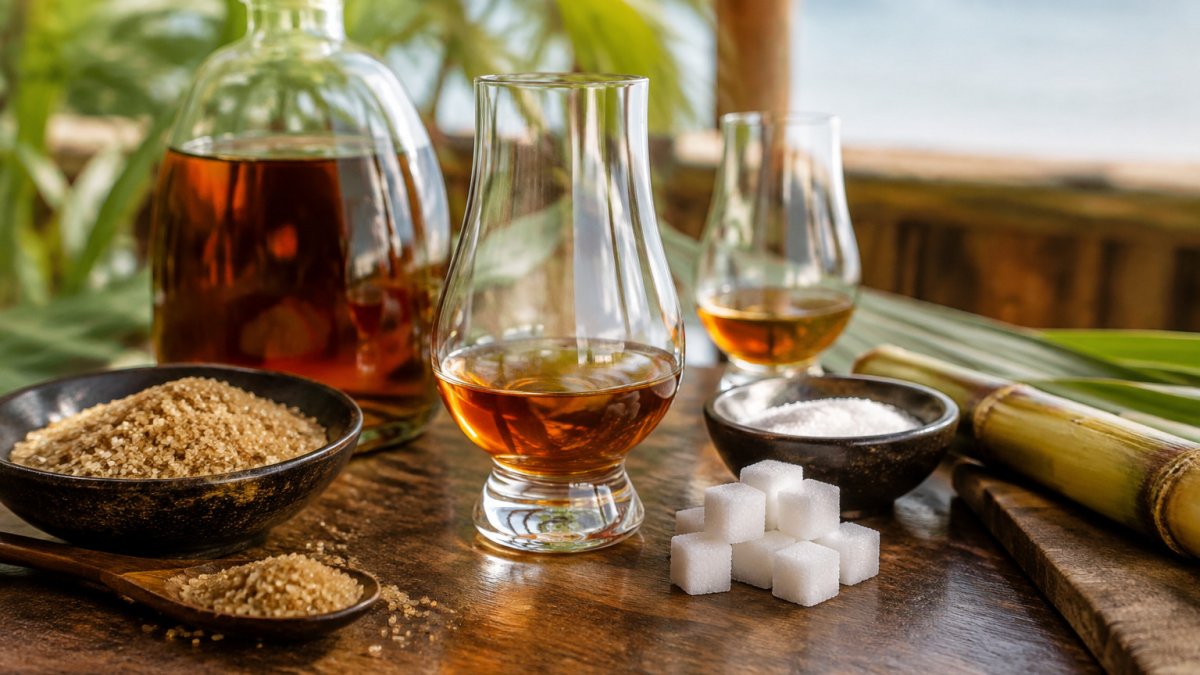
Last Updated: November 5, 2026
Quick Summary
You can detect added sugar in rum by reading the glass for thick, slow legs, nosing for a flat candy-like sweetness that sits above the oak, and tasting for a slick, cloying finish. Confirm your hunch with a hydrometer test: if the measured apparent proof reads higher than the stated proof at the same temperature, dissolved solids are inflating the density.
- Swirl the rum and watch the legs: heavy, slow streaks suggest dosing, though barrel age and proof also add body.
- Barrel sweetness smells integrated with vanilla, caramel and oak, while added sugar sits on top as a flat candy note.
- Hold each sip for a few seconds; dosed rum feels slicker and its sweetness arrives late and lingers.
- Fill a tall cylinder, float the hydrometer, spin off bubbles and read at eye level at the liquid line.
- A gap between stated proof and measured apparent proof at a known temperature is the signal, not the raw number.
Table of Contents
- Why Added Sugar in Rum Is So Hard to Spot
- Step 1: Prep Your Glass, Nose, and Palate Before You Judge
- Step 2: Read the Glass for Viscosity and Legs
- Step 3: Nose the Spirit for Clues Sugar Leaves Behind
- Step 4: How to Taste Rum for Beginners and Catch Dosing on the Palate
- Step 5: Run a Rum Hydrometer Test to Confirm What You Tasted
- How to Read Rum Labels for Hidden Sweeteners and Dosing Clues
- A Tasting Note Vocabulary Cheat Sheet for Spotting Dosed Rum
- Frequently Asked Questions
Why Added Sugar in Rum Is So Hard to Spot
Learning how to detect added sugar in rum starts with one uncomfortable truth: sugar in rum is often invisible.
The tricky part is that sugar rounds off rough edges.
So how do you catch it? You use your glass, your nose, your palate, and one small piece of lab gear.
U.S. Alcohol and Tobacco Tax and Trade Bureau labeling rules
Step 1: Prep Your Glass, Nose, and Palate Before You Judge
Start clean. A dirty glass or a strong-smelling room will ruin your read before you begin. Give yourself a fair setup and the rest of the process gets much easier.
Choosing the Right Glass and Pouring Temperature
Use a tulip-shaped tasting glass or a small copita. The narrow rim traps aroma, which is where sugar clues hide first. Avoid a wide rocks glass, since it lets the volatile compounds escape.
Pour a small measure at room temperature. Cold dulls aroma and hides the very clues you need. Add nothing yet, no ice and no water, until you have done your first pass.
Coating Your Palate for a Clean Read
Rinse your mouth with water before you taste. Skip coffee, mint, or spicy food for at least 30 minutes beforehand. A common mistake is tasting after a meal, when your palate is already coated with fat and salt.
- Water only, no citrus
- Neutral crackers if you need a reset
- Small sips, never gulps
Step 2: Read the Glass for Viscosity and Legs
Viscosity is the fastest visual clue. Swirl the rum gently and watch how it coats the glass. Then look at the “legs” or tears that run down the inside.
A high-sugar rum often leaves thick, slow-moving streaks. A dry, un-dosed spirit tends to leave thinner legs that fall faster.
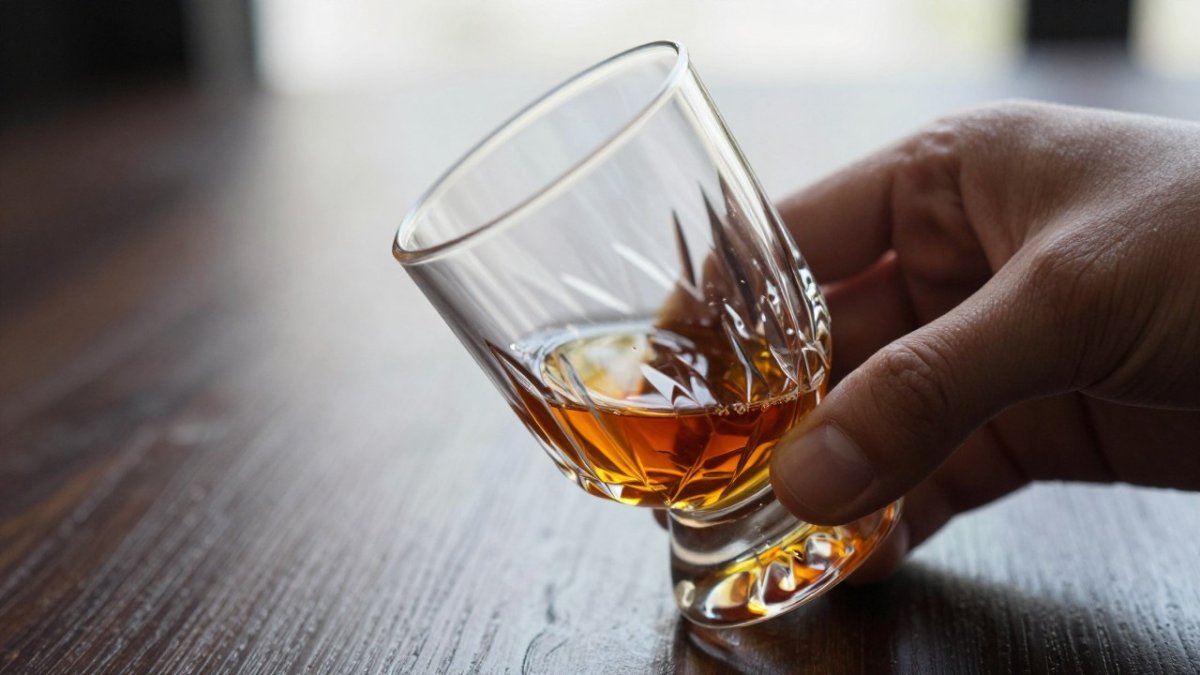
Those slow-running legs can suggest added sweetness, while comparing how texture and body register in craft beer tasting sharpens the distinction between weight and sugar.
If the legs look heavy, note it and keep going. Readers who want to compare body and clarity across styles can explore our white rum picks for mixing to see how a clean spirit should look in the glass.
Step 3: Nose the Spirit for Clues Sugar Leaves Behind
Aroma is where dosing gets loud. Nose the glass gently, then again with a short sniff. Look for the difference between real barrel sweetness and added sugar.
Barrel sweetness smells integrated: vanilla, caramel, dried fruit, and oak all blend together. Added sugar tends to sit on top, smelling flat and one-note.
- Vanilla and caramel from oak: normal
- Toffee that smells like syrup: possible dosing
- A sticky, cloying top note: strong signal
What most guides miss is that sugar can mute the esters and molasses character that make rum interesting.
Step 4: How to Taste Rum for Beginners and Catch Dosing on the Palate
Now take a small sip and let it coat your tongue. Beginners often swallow too fast, which skips the mid-palate where the real tells live. Hold it for a few seconds and pay attention.
A dry rum feels textured and slightly grippy. If you want bottles to practice on, our guide to the best rum for a home bar gives you a starting lineup for side-by-side comparison.
Mid-Palate, Finish, and the Aftertaste Tell
The finish is the giveaway. A clean rum fades with drying oak and spice. A dosed rum leaves a coating sweetness that hangs on the back of your tongue.
Ask yourself one question: does the sweetness feel like it came from the barrel or the bottle? If it tastes like the sugar was poured in, your palate is telling you something.
Step 5: Run a Rum Hydrometer Test to Confirm What You Tasted
The rum hydrometer test turns your hunch into a number. A hydrometer measures the density of a liquid, and dissolved sugar raises that density above what the alcohol and water alone would produce. The mechanism is simple: a fermented and distilled spirit is essentially ethanol, water, and trace congeners, and each of those has a known density at a given proof and temperature.
Here is how we would run it:
- Pour a clean sample into a tall testing cylinder, filling it deep enough that the hydrometer floats freely without touching the bottom.
- Lower the hydrometer gently and let it settle. Spin it slightly to release any bubbles clinging to the stem.
- Read the scale at eye level, at the liquid line, not the meniscus edge.
- Record the temperature of the sample at the same moment you take the reading.
- Compare the reading against the expected density for that stated proof at that temperature.
- A higher-than-expected reading points to dissolved solids, often sugar.
What the Numbers Actually Mean
A hydrometer calibrated for spirits reads in proof or in specific gravity depending on the model. The key comparison is between the label proof and the measured apparent proof at a known temperature. If a bottle states 80 proof (40% alcohol by volume) and the hydrometer reads noticeably higher than 80 at the same temperature, dissolved solids are inflating the density.
Temperature, Calibration, and the Failure Modes
Watch out: temperature shifts the reading, so test at a consistent room temperature and note it. Most hydrometers are calibrated at a specific reference temperature, often around 60°F or 68°F depending on the model, and a sample several degrees off that reference will read inaccurately.
Other failure modes to rule out before you blame sugar:
- Carbonation or bubbles on the hydrometer stem lift it and inflate the reading. Let the sample rest and spin the hydrometer.
- A dirty cylinder or residue from a previous sample changes density. Rinse and dry between tests.
- High-proof spirits can be hard to read because the hydrometer sits low; dilute only if your instrument’s range requires it, and account for the dilution in your math.
Your senses and the hydrometer together make a far stronger case than either one alone. If you want to compare a dosed pour against a clean one in person, you can visit a Tiburon tasting room for a guided flight.
How to Read Rum Labels for Hidden Sweeteners and Dosing Clues
Reading rum labels is where most drinkers give up. Sugar is rarely listed, and words like “smooth” or “premium” say nothing about what is in the bottle. You have to read between the lines, and you have to know what the label is and is not required to tell you.
What U.S. Labeling Rules Do and Do Not Require
The U.S. Alcohol and Tobacco Tax and Trade Bureau regulates labeling for distilled spirits, and its rules govern the mandatory statements you see on every bottle: brand name, class and type designation, alcohol content, net contents, and the government warning (Distilled Spirits Labeling).
U.S. Alcohol and Tobacco Tax and Trade Bureau labeling rules
This is why label reading is a screening tool, not a verdict. You are looking for signals that either raise or lower your suspicion before you ever pour a glass.
Terms That Signal Added Sugar and Terms That Don’t
Some label language hints at dosing, and some is just marketing noise. Here is how we sort them.
| Label Term | What It Usually Means | Dosing Signal |
|---|---|---|
| “Smooth” or “mellow” | Softened mouthfeel | Weak clue |
| “Añejo” or “aged” | Time in barrel | Neutral |
| “Sherry cask finish” | Sweet barrel influence | Neutral |
| “Sweet” or “dessert” | Literal sweetness | Strong clue |
| “No additives” | Producer claim | Check proof |
| Proof number stated | Transparency | Good sign |
| “Rum liqueur” or “spiced” | Added sugar likely by definition | Strong clue |
A stated proof is a positive sign, since it tells you the strength and leaves less room to hide. Vague sweetness claims with no proof number deserve a closer look. For a deeper read on how small producers differ from mass-market bottling, see our breakdown of small batch versus mass produced rum.
The Label Details Most Drinkers Skip
Three details on the back label do more work than the front. First, the class and type designation: a bottle labeled simply “rum” is held to the standard identity for the category, while a bottle labeled “spiced rum” or “rum liqueur” is telling you sweetness is part of the product by definition. Second, the alcohol content statement: a precise figure like 40% alcohol by volume is more useful than a rounded proof, because it gives you the number to check against your hydrometer. Third, the country of origin and any age statement: age statements are regulated, but they describe time in barrel, not what happened after.
A Tasting Note Vocabulary Cheat Sheet for Spotting Dosed Rum
Words shape what you notice. A shared vocabulary helps you compare bottles and spot dosing faster. Here is the cheat sheet we use.
- Viscosity: how thick the rum feels and looks in the glass
- Legs: the streaks that run down after a swirl
- Mouthfeel: the physical texture on your tongue
Use three words per bottle and write them down. Over time, your notes will show patterns, and dosed rums will stand out against clean ones.
Frequently Asked Questions
Does all rum contain added sugar?
No. Plenty of rums are bottled with nothing added after distillation and aging, while others are dosed with sugar syrup, molasses, or caramel before bottling. The range is wide, and labeling rules do not force most producers to disclose it, which is why sensory checks and a hydrometer test matter. A rum that tastes dry, with a short clean finish, is far less likely to carry heavy dosing than one that feels syrupy and sweet from the first sip.
Does the hydrometer test work for detecting sugar in rum?
It works as a rough check, with limits. A hydrometer measures density, so dissolved sugar raises the reading above what the stated proof alone would produce. The catch is that age, barrel character, and other dissolved solids also shift density, so a high reading is a flag, not proof. Run the test at a consistent temperature, compare the measured specific gravity against the expected figure for the label proof, and treat any gap as a reason to taste more carefully.
What is the difference between natural sweetness and added sugar in rum?
Natural sweetness comes from the molasses or cane juice, from esters formed during fermentation, and from compounds pulled out of the barrel during aging, such as vanillin and lactones from charred oak. It reads as layered and integrated with the aroma. Added sugar sits on top of the spirit: it shows up as a thick, coating texture, a candy-like lift on the nose, and a sweet note that lingers after the other flavors have gone. Learning how to taste rum for beginners means learning to tell those two apart.
How can you tell if rum has been dosed with sugar before you open the bottle?
Start with how to read rum labels: look for words like sweetened, liqueur, or spiced, and treat a very low stated proof on an aged expression as a prompt to taste carefully. Beyond that, check whether the producer publishes dosage figures, which some do voluntarily. If nothing is disclosed, buy a single bottle first, pour a small measure, and run the glass and palate checks before committing to a full bottle or a case.
Spotting added sugar takes practice, but the payoff is a sharper palate and better bottles on your shelf. At Tiburon Rum, we craft our molasses-based rum in a family-owned Belizean distillery and mature it in bourbon barrels, with a second maturation for color and a smooth finish, and our 92-proof White Tip is built for mixing. No shortcuts, no syrup. Get started with Tiburon Rum and taste what an honest, barrel-forward spirit should be.
