
Last Updated: November 3, 2026
Quick Summary
Renewable energy can be worth it for agave processing when it matches the right load. Process heat is usually the largest energy use, so solar thermal and bagasse-fired biomass are often the first options to evaluate. A stage-by-stage energy audit should come before any purchase.
- Process heat is usually the largest single energy load in agave processing.
- Bagasse can be burned for heat, but drying, transport, and ash handling add cost.
- Solar thermal suits heating loads, while photovoltaic panels suit electrical loads.
- Log energy use by processing stage over several months before choosing technology.
- Confirm federal tax credit eligibility with a qualified tax professional before committing.
Table of Contents
- Why Agave Processing Needs So Much Energy
- Agave Biomass and Bagasse as an Energy Source
- Solar Thermal and Photovoltaic Options for Distilleries
- Auditing Your Facility to Choose the Right Technology
- Capital Costs, Payback and Technology Readiness
- Federal Tax Credits and Incentives for Manufacturers
- Choosing Your First Step Toward Renewable Processing Energy
- Frequently Asked Questions
Why Agave Processing Needs So Much Energy
Agave processing is an energy-intensive business, and the energy goes into a few distinct stages: cooking or steaming the piñas, extracting juice or fermenting the mash, distilling, and running the plant that handles water and residues. For a distillery deciding whether renewable energy is worth the investment, the question starts with where its own energy actually goes. Tiburon Rum’s own experience of running a family-owned distillery in Belize shows how much depends on local fuel prices, plant layout, and seasonal production volume.
Process heat is usually the largest single load. Cooking and distillation require steady thermal energy, which is why solar and biomass options are often judged first on how well they can supply heat rather than electricity. Electricity demand then follows from pumps, milling, cooling, and lighting. Keeping track of these loads separately makes it much easier to match a renewable source to the part of the process it can realistically cover.
Water use is also tied to energy. Heating and cooling water consume energy directly, so efficiency measures that reduce water demand often reduce energy costs at the same time. Many processors find that small changes in water handling produce savings that are easier to justify than a large new energy system.
Agave Biomass and Bagasse as an Energy Source
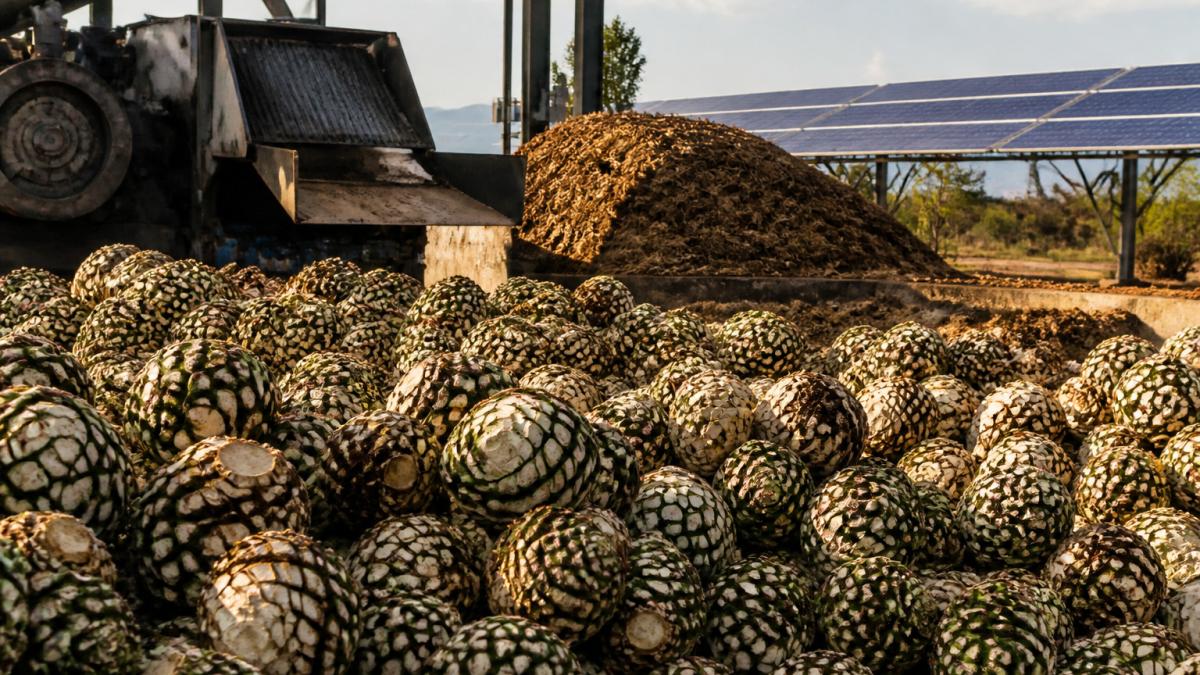
After the juice is extracted, the fibrous residue known as bagasse remains. This material is a biomass resource that can be burned for heat or converted into other fuels, which makes it attractive for processors looking to reduce purchased fossil fuel. Its practical value depends on moisture content, how consistently it is produced, and whether the facility has a place to store and handle it.
Bagasse is not a free resource in every case. Drying it, transporting it, and managing ash all require equipment and labor. Facilities that already have a boiler or furnace set up for combustion are often better positioned to use bagasse directly than facilities that would need to build new infrastructure around it.
Converting Bagasse to Biogas and Bioethanol
Bagasse can also feed conversion processes. Anaerobic digestion can turn organic residues into biogas, which can be used for process heat or electricity. Fermentation and distillation can turn sugary streams into bioethanol. Each route involves different equipment, different feedstock requirements, and different output. Before choosing one, a processor should compare the energy yield per unit of residue, the capital cost of the equipment, and whether the output can be used on site or must be sold, since transport and storage can erase much of the advantage.
Solar Thermal and Photovoltaic Options for Distilleries
Solar energy comes in two broad forms that serve different needs. Solar thermal systems collect sunlight to produce hot water or steam, which maps directly onto the heating loads in cooking and cleaning. Photovoltaic systems convert sunlight into electricity, which suits pumps, lighting, and control systems (How Does Solar Energy Work?). Many distilleries that have looked at solar find that the thermal option is better matched to process heat, while photovoltaic panels fit more naturally on roofs or nearby land where the electricity can offset grid purchases.
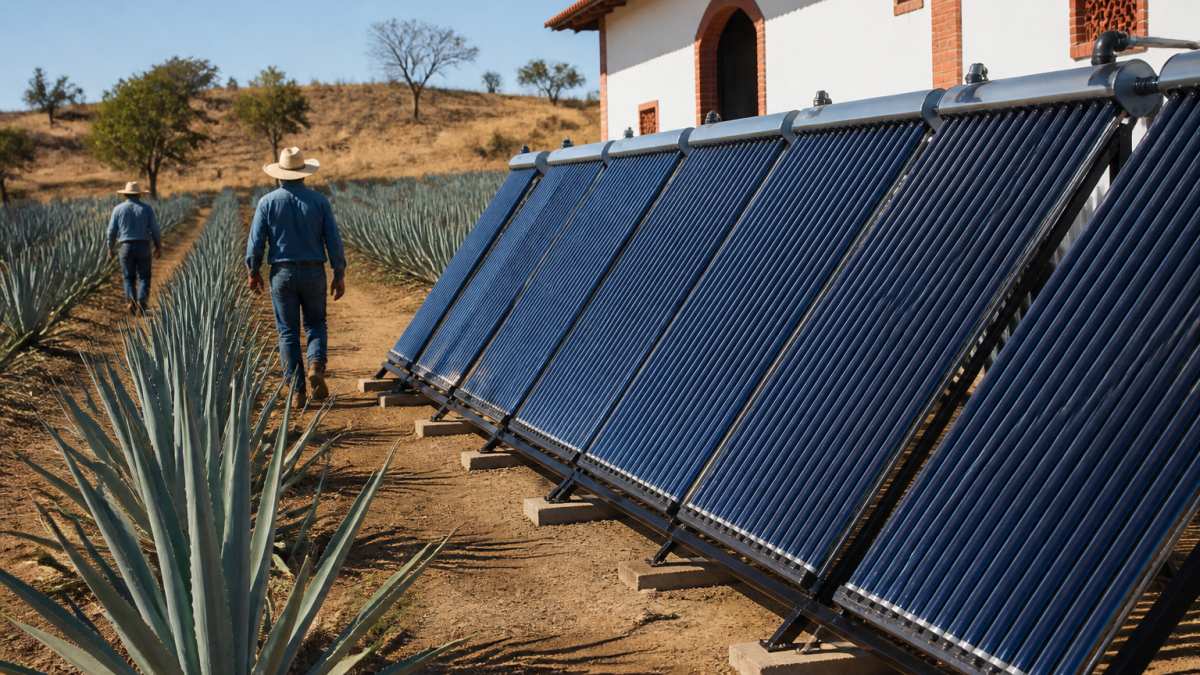
Land use is a real consideration in agave regions. Panels or collectors placed on land that could otherwise be used for crops require a trade-off, though some operators place arrays alongside or between cultivation areas. Site layout, shading, and access for maintenance all affect how much usable output a system delivers over its life.
Auditing Your Facility to Choose the Right Technology
Choosing a renewable technology without first measuring energy use is a common way to waste money. The most useful audit for an agave processor is not a building-wide utility review but a stage-by-stage load profile, because each stage of processing has a different energy quality requirement and therefore a different best-fit renewable source. A stage-by-stage load profile also makes it easier to compare renewable energy for agriculture with the specific heat and power demands of agave processing.
Build the load profile by stage. Log consumption separately for each of the following, ideally over several months so seasonal production swings are captured:
- Cooking and steaming. This is a thermal load, typically delivered as steam or hot water at moderate pressure. Record the temperature setpoint, the steam or hot-water flow, and the hours per batch. Solar thermal and biomass boilers compete for this load.
- Milling and juice extraction. Mostly electric motor load. Record motor nameplate ratings, run hours, and whether variable-frequency drives are already installed.
- Fermentation and cooling. Chilled-water and pumping loads, largely electric. Record chiller run hours and the temperature band required.
- Distillation. A large, steady thermal load plus cooling-water pumping. Record reboiler or steam demand and the cooling loop’s electricity use.
- Wastewater treatment and residuals handling. Aeration blowers and pumps are significant electric loads, and anaerobic digestion of high-strength wastewater can offset them.
- Plant utilities. Lighting, compressed air, and HVAC, which are usually the easiest loads to reduce before sizing any renewable system.
Record the right fields for each load. For every piece of equipment, capture the energy carrier (steam, hot water, electricity, or fuel), the temperature or power level required, the duty cycle and hours of operation, and whether the load is continuous or batch. Batch loads and continuous loads are matched very differently: a continuous distillation reboiler suits a steady source like a biomass boiler, while a batch cooking load can be served by a solar thermal array with buffer storage sized to the batch cycle.
Match source to load, not the other way around. With the profile in hand, rank options by how much of a specific load each can realistically cover. A solar thermal array that displaces most of the cooking-stage fuel may deliver more value than a larger photovoltaic project that offsets only a fraction of total electricity demand. The audit also surfaces efficiency measures, insulation on steam lines, heat recovery from condensers, better scheduling of batch runs, that shrink the renewable system you need to buy.
Watch out: an audit that reports only total kilowatt-hours and total fuel spend hides the load shape, and load shape is what determines whether a solar thermal, photovoltaic, biomass, or biogas system will actually perform as promised.
Capital Costs, Payback and Technology Readiness
Renewable projects are judged by capital cost, operating cost, and payback period, and each varies widely by technology and scale. What makes this section useful is comparing the cost structure of each option on the same basis, then layering technology readiness and financing on top.
Compare cost structure, not just sticker price. For each candidate technology, build a simple table with the same line items so options are comparable:
- Installed capital cost. Equipment, balance of system, installation labor, structural or civil work, and any changes to existing boilers, steam headers, or electrical service. Solar thermal and photovoltaic systems have high upfront cost but low operating cost; biomass boilers have moderate capital cost but ongoing fuel handling and ash management.
- Fixed operating cost. Maintenance contracts, monitoring, insurance, and replacement parts. Solar systems are largely fixed and predictable; combustion and digestion systems carry more variable maintenance.
- Variable operating cost. Fuel or feedstock cost, labor for handling, water, and disposal of ash or digestate. Bagasse that is already on site has a low marginal fuel cost but real handling and drying cost.
- Annual energy cost avoided. Value the displaced energy at the actual delivered cost of the fuel or electricity it replaces, including demand charges for electric loads.
- Simple payback. Divide installed capital cost by annual energy cost avoided, then stress-test it against a low-production year.
Layer in financing and incentives. Federal tax credits and accelerated depreciation can materially change payback, and the eligibility rules depend on technology, project size, ownership structure, and when construction begins (Home energy tax credits). Confirm current terms with a qualified tax professional and with official guidance from the U.S. Department of the Treasury and the Internal Revenue Service. State and local programs, utility rebates, and on-bill financing may add to or limit federal benefits, so check those as well. Third-party ownership and power purchase agreements can move capital cost off the balance sheet for electricity projects, though they are less common for process-heat systems.
Score technology readiness honestly. Some options are mature and widely understood, combustion of bagasse in an existing boiler, solar thermal for hot water, and photovoltaic systems for electric load. Others, such as certain conversion routes for agave residues, are still being demonstrated at commercial scale. Score each option on commercial maturity, feedstock variability tolerance, equipment reliability, permitting complexity, and operator skill required. Ask suppliers for operating data from comparable installations rather than relying on projected figures, and ask specifically how the system performs when feedstock moisture or production volume varies.
Watch out: a payback calculation built on nameplate output and ideal feedstock will understate real cost, because downtime, feedstock variability, and maintenance are where most projects miss their projections.
Federal Tax Credits and Incentives for Manufacturers
Federal tax policy can change the economics of renewable investment, and manufacturers in the United States should review current federal tax credits and depreciation rules with a qualified tax professional before committing to a project. Incentive programs change over time, and the eligibility rules for a given technology can depend on project size, ownership structure, and the date construction begins. Official guidance from the U.S. Department of the Treasury and the Internal Revenue Service is the authoritative place to confirm current terms (Treasury, IRS provide guidance for certain energy tax credits regarding material…). State and local programs may add to or limit federal benefits, so those should be checked as well.
Choosing Your First Step Toward Renewable Processing Energy
For most processors, the best first step is a measured energy audit rather than an immediate equipment purchase. Once the loads are clear, compare two or three options against capital cost, payback, and readiness, and ask for performance data from installations that resemble your own. If you want to talk through your facility with the Tiburon Rum team, use the contact page to start that conversation. That is where you can ask about our own distillery operations and what we have learned from running a family-owned plant in Belize.
Frequently Asked Questions
How is agave waste used for renewable energy?
Agave processing leaves behind large volumes of fibrous bagasse and other residues. These materials can be dried and burned for process heat, or they can be fed into anaerobic digesters to produce biogas. Some operations convert the sugar-rich fraction into bioethanol. The most suitable route depends on moisture content, the volume produced, and whether the facility needs heat, electricity or liquid fuel. A facility audit should measure residue volumes before any technology is selected.
Can solar power be integrated into agave cultivation and processing?
Yes. Photovoltaic panels can supply electricity for pumps, lighting and controls, while solar thermal collectors can preheat water or provide low-temperature process heat. Some producers explore co-locating solar equipment with agave fields, though land use and shading need careful planning. Solar output varies with season and weather, so most facilities pair solar with a backup source or storage. Verified performance data should be requested from equipment suppliers before purchase.
Are there government incentives for renewable energy in the spirits industry?
Federal tax credits for renewable energy and energy-efficient equipment are available to manufacturers in the United States, but eligibility depends on the technology, the project’s placed-in-service date and the business structure. Producers should confirm current program rules with a tax advisor and with the Internal Revenue Service guidance in effect at the time of purchase. Some states also offer their own incentives, so local programs should be checked as well.
