
Last Updated: November 6, 2026
Quick Summary
To use a hydrometer for rum testing, fill a clean test jar three-quarters full, lower the spirit-scale instrument gently by its stem, spin it to release bubbles, and read the scale at the bottom of the meniscus at eye level. Record the reading with the sample temperature, then apply your instrument’s correction chart.
- Choose a spirit-scale hydrometer, not a brewing hydrometer that reads specific gravity.
- Rinse the test jar with rum first, since leftover water dilutes the sample and lowers the reading.
- Proof equals twice the ABV, so a 46% ABV rum reads 92 proof.
- Most spirit hydrometers are calibrated to 60°F or 68°F, so note the sample temperature.
- Sweetened or spiced rum readings are estimates because dissolved sugar skews the density.
Table of Contents
- Why a Hydrometer Belongs in Every Rum Lover’s Toolkit
- Alcohol Hydrometer vs. Brewing Hydrometer: Pick the Right Instrument
- What You’ll Need Before You Test Rum
- Step-by-Step: How to Use a Hydrometer for Rum Testing
- Reading Your Alcohol Hydrometer Reading Chart
- Using a Hydrometer Alcohol Calculator for Proof and ABV
- Temperature Correction: Getting Accurate Readings
- How to Test Alcohol Content Without a Hydrometer
- Frequently Asked Questions
Why a Hydrometer Belongs in Every Rum Lover’s Toolkit
A hydrometer for rum testing is a sealed glass instrument that floats in a sample of spirit and shows its alcohol content on a printed scale. It turns guesswork into a number you can trust.
Drinkers want to know what is actually in the bottle. A hydrometer answers that in under a minute.
Here is the part most guides skip: the instrument sold for brewing beer will mislead you on distilled spirits. Rum needs a different tool, and this guide shows you which one.
Below, we walk through the full process, from picking the right instrument to converting your reading into proof. You will also learn where sugar and temperature throw the numbers off.
Alcohol Hydrometer vs. Brewing Hydrometer: Pick the Right Instrument
An alcohol hydrometer measures ethanol in a finished spirit. A brewing hydrometer measures sugar density in fermenting liquid. They are not interchangeable.
The brewing version, often called a specific gravity hydrometer, tracks original gravity and final gravity during fermentation. It reads a wash, wort, or mash before distillation.
The spirit version reads alcohol by volume directly. Some models carry a proof-and-tralle scale for both proof and strength.
Buy the wrong one and your rum reading means nothing. Check the scale before you buy:
- Spirit scale: reads ABV or proof, used on distilled spirits
- Brewing scale: reads specific gravity, used on beer and wash
- Dual scale: rare, but handy if you also home-brew
For rum, choose the spirit instrument every time.
What You’ll Need Before You Test Rum
Gather your gear first so the sample stays cold and undisturbed. The setup takes two minutes.
You need:
- A clean test jar or test cylinder, tall enough for the hydrometer to float free
- An alcohol hydrometer with a spirit scale
- A sample of rum at room temperature or cooler
- A notebook for your readings
- A thermometer if your instrument is calibrated to a set temperature
Rinse the jar with a little of the rum first. Water left in the cylinder dilutes the sample and drags the reading down.
Watch out: a jar that is too narrow makes the hydrometer rub the sides. It sticks, and you read the wrong number.
Step-by-Step: How to Use a Hydrometer for Rum Testing
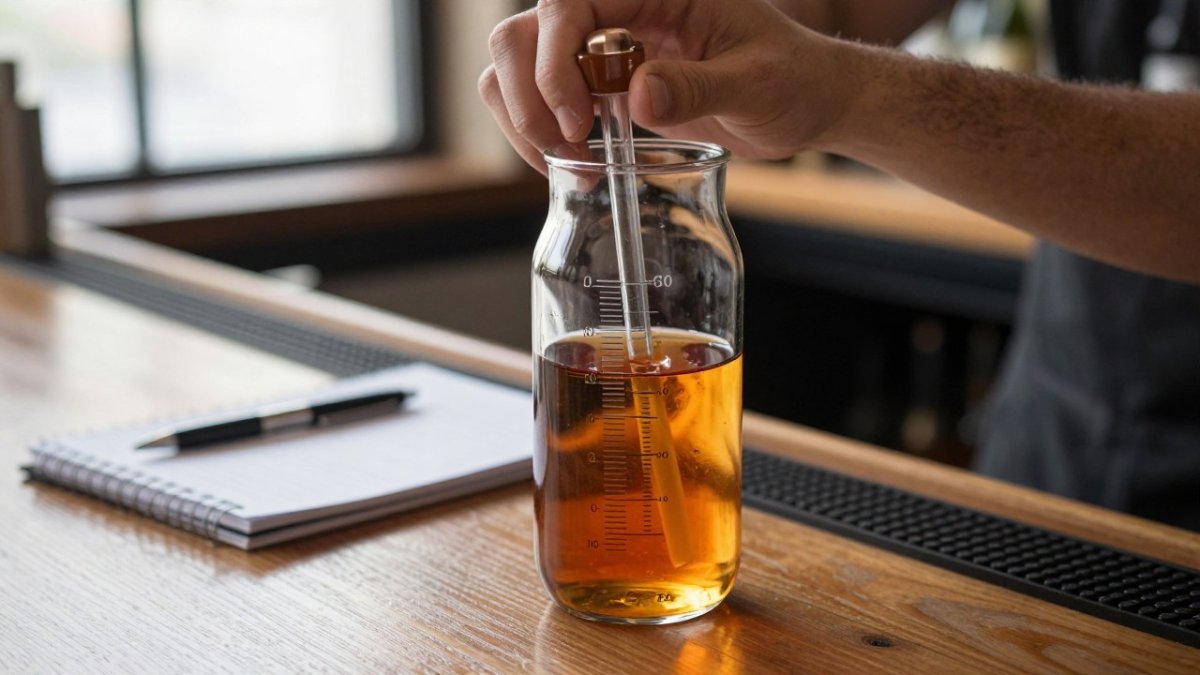
Using a hydrometer for rum takes about three minutes once your gear is ready. Fill, float, spin, and read. That is the whole method.
Step 1: Fill the Test Jar and Cool the Sample
Pour rum into the test jar until it is about three-quarters full. Leave room for the instrument to float without spilling.
Let the sample settle. Warm liquid expands and reads lighter than it should, so a cooled sample gives a truer number.
Step 2: Lower the Hydrometer and Spin Off Bubbles
Lower the hydrometer gently by its stem. Do not drop it. A dropped instrument can crack or lose its weighted base.
Once it floats, spin it lightly. The spin releases bubbles clinging to the glass. Bubbles add lift and push the reading high.
Let it settle on a level surface. Wait until it stops bobbing.
Step 3: Read the Scale at the Meniscus
Read the scale where the liquid surface meets the glass. That curve is the meniscus. Take the number at the bottom of the curve, at eye level.
Write the reading down along with the sample temperature. You will need both for the next step.
Reading Your Alcohol Hydrometer Reading Chart
An alcohol hydrometer reading chart converts the float line into a strength figure. Most spirit instruments print the scale directly on the stem, so no chart is needed for the raw number.
The reading itself is where most beginners lose accuracy. Read the scale where the liquid surface meets the glass. That curve is the meniscus. Take the number at the bottom of the curve, with your eye level with the surface.
A typical spirit scale reads in ABV or in proof, and some carry both plus a tralle scale for strength. Know which line you are reading before you write anything down.
This is the part most guides skip for rum. A proof-and-tralle alcoholmeter is built for an ethanol-water mixture. Sweetened, spiced, or otherwise flavored rum carries dissolved sugar and other solids that change the density of the sample.
What that means in practice:
- A dry or lightly sweetened rum gives the cleanest alcoholmeter reading
- A sweetened or spiced rum reading is an estimate, not a certified figure
- For a label-grade number on a flavored spirit, laboratory analysis is the reliable route
Watch out: do not ‘correct’ a sweetened rum reading with a temperature chart and call it accurate. The sugar error and the temperature error are separate problems, and the chart only addresses one of them.
Keep a printed chart in your bar kit for temperature work, and keep a notebook for the raw reading, the sample temperature, and the scale you used. That record is what lets you compare bottles honestly later.
Using a Hydrometer Alcohol Calculator for Proof and ABV
A hydrometer alcohol calculator turns your reading into ABV and proof. The math is simple enough to do by hand.
In the US, proof is twice the alcohol by volume (Distilled Spirits FAQs). A spirit at 46% ABV is 92 proof. White Tip rum is bottled at 92 proof, a strength that suits mixing.
The formula:
- ABV × 2 = proof
- Proof ÷ 2 = ABV
So a reading of 40% ABV equals 80 proof. A reading of 50% ABV equals 100 proof.
Most online calculators just run this doubling for you. Useful, but you can skip the website and do it in your head.
Temperature Correction: Getting Accurate Readings
Temperature correction adjusts a reading to the instrument’s calibration temperature. Skip it and a warm sample can read a point or two off. Most spirit hydrometers are calibrated to a stated temperature printed on the stem or in the paperwork, commonly 60°F or 68°F.
Here is the mechanism. Ethanol and water expand as they warm, so a warm sample is less dense. The hydrometer sinks deeper and the float line lands lower on the scale, which shows a weaker strength than the true figure.
A practical workflow:
- Note the calibration temperature on your instrument.
- Take the sample temperature with a thermometer right after you read the scale.
- Find the correction for that temperature in the chart that came with the instrument, or in a published alcoholmeter correction table.
- Apply the correction to the raw reading and record both numbers.
A worked example makes it concrete. Suppose your hydrometer is calibrated to 60°F and your rum sample sits at 80°F. The liquid has expanded, so the instrument shows a lower strength than the true figure.
Three habits keep you accurate:
- Test at or near the calibration temperature when you can
- Note the sample temperature every time, even when you skip the correction
- Use the correction chart that matches your instrument rather than a generic rule of thumb
Watch out: correction tables are instrument-specific. A chart built for one calibration temperature will push your numbers the wrong way on a hydrometer calibrated to a different mark.
For casual tasting, small temperature swings barely matter. For record-keeping or comparing bottles, they do. If you plan to log readings across several sessions, keep the thermometer and the chart in the same kit so the workflow stays consistent.
Here is the temperature workflow the article lays out, from noting the calibration mark to recording the corrected figure.
| Step | What to do | Note |
|---|---|---|
| 1 | Note the calibration temperature on your instrument | Commonly 60°F or 68°F |
| 2 | Take the sample temperature right after reading the scale | Use a thermometer |
| 3 | Find the correction in the chart that came with the instrument | Instrument-specific tables only |
| 4 | Apply the correction and record both numbers | Raw reading plus corrected figure |
| Warm sample | Instrument sinks deeper, float line lands lower | Shows weaker strength than true figure |
| Cold sample | Liquid contracts, instrument rides higher | Reading climbs above true figure |
How to Test Alcohol Content Without a Hydrometer
You can estimate alcohol content without a hydrometer, but expect a rough figure rather than a precise one. A refractometer is the closest substitute. It reads a few drops on a glass plate and gives a strength estimate.
Other options:
- Refractometer: fast, needs only a few drops, best for quick checks
- Laboratory analysis: the most accurate route, and the most expensive
- Distillation test: accurate but needs equipment most home bars lack
One caution applies to every method. Sugar, flavoring, and aging add dissolved solids that skew a reading. Sweetened and spiced rums read high on some instruments because the sugar, not the ethanol, is bending the number.
That is why we suggest testing a dry or lightly sweetened rum first. If you want a shortlist of bottles worth testing, our guide to the best rum for home bar covers eight we keep on hand, and our picks for the best white rum for mixing suit anyone testing a lighter spirit.
Our tasting rooms in Placencia Village and San Pedro welcome anyone who wants to taste alongside people who know the bottles.
Testing rum at home rewards curiosity, and a hydrometer is the cheapest way to satisfy it. Grab a spirit-scale instrument, keep your samples cool, and write down every reading. You will learn more about proof in one evening than in a year of label reading.
Tiburon Rum’s molasses-based rum is handcrafted in a family-owned Belizean distillery and matured in bourbon barrels. White Tip rum is 92 proof and suits mixing. The rum offers a smooth finish with tropical vanilla undertones, and the brand supports conservation efforts in Belize.
Frequently Asked Questions
Can an alcohol hydrometer measure the ABV of finished rum?
Yes, an alcohol hydrometer designed for distilled spirits can measure the ABV of finished rum. Fill a test jar with a sample, lower the hydrometer, spin it to release bubbles, and read the scale at the liquid surface. Keep in mind that sugar and flavoring can affect the reading, so a hydrometer for rum works best on clear, unsweetened spirits. For sweetened or aged rums, treat the result as an estimate and cross-check with the label.
What is the difference between an alcohol hydrometer and a brewing hydrometer?
An alcohol hydrometer measures the strength of distilled spirits directly, with a scale in ABV or proof. A brewing hydrometer measures specific gravity in fermenting liquids like wort or wash, so brewers can track fermentation and calculate alcohol later. If you want to test rum, choose an alcohol hydrometer. A brewing hydrometer will float in rum but its gravity scale will not tell you the ABV without a calculation.
How do temperature and calibration affect an alcohol hydrometer reading?
Hydrometers are calibrated to a specific temperature, often 60°F or 68°F. If your rum sample is warmer or cooler, the reading will drift. Let the sample settle to room temperature or use a temperature correction chart to adjust the result. Always check the calibration temperature printed on the hydrometer and test it in distilled water first. A reading taken at the wrong temperature can be off by several proof points.
Can you test rum alcohol content without a hydrometer?
You can estimate alcohol content without a hydrometer using a refractometer, but it is less accurate for spirits with sugar. Another option is the proof-and-tralle method, which uses a specialized glass instrument, though it is less common. For home testing, a hydrometer remains the most reliable and affordable tool. If you have no instrument, rely on the bottle label and treat any homemade estimate as rough.
